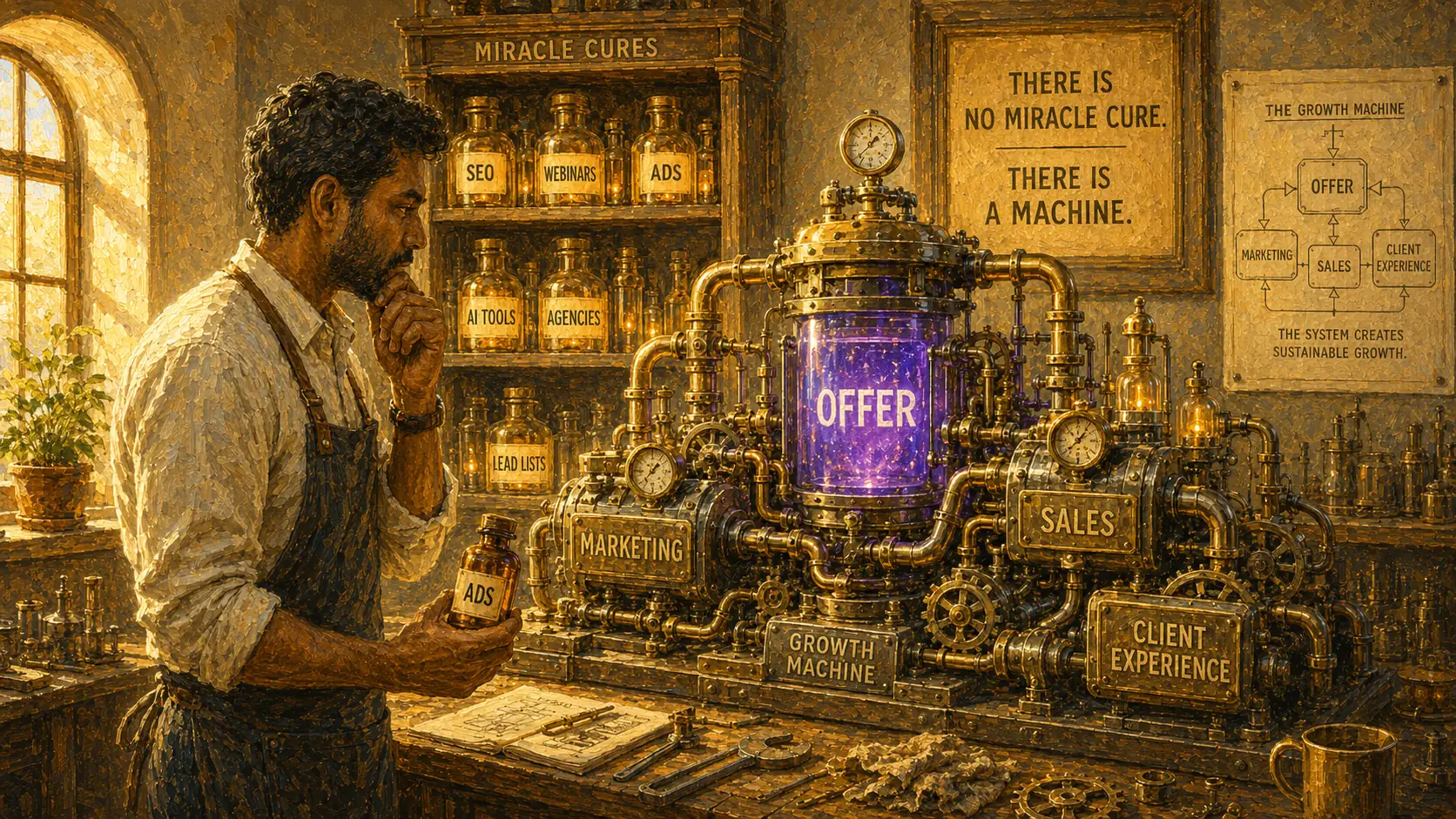
Most of the case studies on this site start with an offer problem. This one starts with everything: a full growth machine build, with sales at the center of it. I'm sharing it anyway, because right in the middle of a sales-first engagement, offer design showed up and did the heaviest lifting in the whole story. Watch for it.
The Client
Inflow was a digital marketing agency specializing in e-commerce companies. Fifteen years in business. Multiple seven figures in revenue. A prestigious industry list sending a steady stream of referrals.
And revenue had been flat for years. Almost to the penny.
Founder Mike Belasco was overwhelmed. He'd hired multiple salespeople. Every one of them flamed out, and every time, he got sucked back into sales. SEO clients were complaining and canceling too often. The conversion rate optimization department was losing money. Nearly every lead came from a single industry list, and Mike knew that if the list ever went away, the pipeline would dry up overnight. (It eventually did go away. Keep reading.) And the leads that weren't e-commerce? Straight in the garbage, because nobody had time to deal with them.
How We Built the Machine
You can't fix everything at once in a business that's been running for 15 years. So we ran a simple cycle on repeat: pick a problem, diagnose the root cause, develop a solution, implement it, then track and optimize. Nothing exotic. Just regimented, over and over.
The Five-Step Cycle
Then repeat. Every problem below went through the same cycle.
Problem One: SEO Clients Kept Leaving
Diagnosis showed the churn started before clients ever signed. Poor client selection. Poor expectation setting. An SEO team with almost no voice in the sales process.
So we built client selection criteria with the SEO team itself (they're the ones doing the work, so they know what a good client looks like), created a simple lead scoring system, and added a green-light step where the SEO manager approved every pitch. New expectation-setting slides laid out the six-month roadmap up front, so the "when are you doing the link building?" calls stopped.
The SEO team started receiving what I call winnable games: clients where the factors were stacked in their favor to do great work. Complaints went down. Retention went up. Revenue went up too, helped by higher minimum fees. That last part is an offer design move, by the way. Not a sales trick.
Problem Two: The Offers (Here's the Part That Matters Most)
Inflow had exactly one conversion rate optimization service: an A/B testing program. It was excellent. It was also a fit for a fraction of the prospects who called in. Everyone else lacked the budget or the traffic to qualify, and for years the answer to "can't you just do an audit?" was no.
We designed new offers:
The Express Review
A fixed-fee audit for low-traffic sites. The exact thing prospects had been asking for, for years, finally became a product.
Design-phase optimization
For companies building brand new websites who wanted the site optimized as it was designed, before a single test ever ran.
Specialty projects
Narrow, well-defined scopes like site speed. Small offers that fit real situations instead of forcing every buyer into one program.
Suddenly there was a right-sized offer for nearly everyone who called.
"Offer design increased the sales and the profitability of the CRO department. The better fit offers did the heavy lifting."
Better sales skills contributed. Better process contributed. But the department turned around because the offers finally fit the buyers. That's why your offer is the first place to look. It drives results before you fix much else.
Problem Three: A Sales Machine Only Mike Could Run
Mike could sell because he was a passionate founder who knew the work cold. That's also why nobody could replace him. There was no process. Scoping was bespoke every time. The CRM was poorly configured. No playbook, no templates, no performance tracking. He was running what I call the sales unicorn strategy: expecting one hire to do the admin, hunt the business, close the business, and be the subject matter expert. Those people exist. They're rare, they're expensive, and they're not a scalable strategy.
We rebuilt the sales process end to end. A strategic discovery template. A team-sell approach that brought SEO, ads, and CRO experts into pitches with ready-made sales engineering slides. A full sales playbook with shared definitions, step-by-step process, templates, and training videos. Then we layered on conversion tracking at every stage, so a weak spot in the funnel pointed straight at its root cause.
One more thing. Those poor-fit leads that used to go in the trash? We set up referral partnerships with other agencies instead, and those discarded leads turned into a five-figure stream of free money.
The Results
Revenue
7 Figures
Of new annual recurring revenue added in a little over a year.
Pipeline
2x
Monthly lead flow doubled, and lead sources grew from one to a handful, including trade shows and SEO.
The Founder
100%
Of sales came off Mike's plate, for the first time ever. An internal subject matter expert took over and ran the machine.
The CRO department didn't just become profitable. It became profitable enough to sell, and it was sold. The referral stream from poor-fit leads kept growing year after year.
Here's Mike:
"Forrest implemented his growth system at my agency, and sales took off like a rocket. There is no doubt this stuff works really well."
The Kicker
Remember that single lead source Mike was worried about? The list did eventually go away. By then, it didn't matter. The pipeline had several other sources feeding it.
And a few years later, Mike exited the business. The systems and processes we built raised the company's valuation and made it sellable without him. That's the whole point of a growth machine. It runs whether the founder is in the room or on a beach.
What This Means for Your Business
This engagement touched everything: sales process, lead generation, retention, tracking, team structure. And still, the single highest-leverage move in the whole build was redesigning a set of offers so they fit the buyers who were already calling. No new traffic. No new tactics. Just offers shaped to match demand that was standing right there.
So before you hire another salesperson or buy another tactic, ask the question Inflow's diagnosis forced: do your offers fit the people who are already showing up? If the answer is no, that's your first fix. Everything else in the machine gets easier after it.
Do your offers fit the buyers who are already calling?
The Offer Design Assessment is a five-minute self-scoring tool that shows you where your offer is strong, where it's soft, and what to fix first.
Take the Assessment →