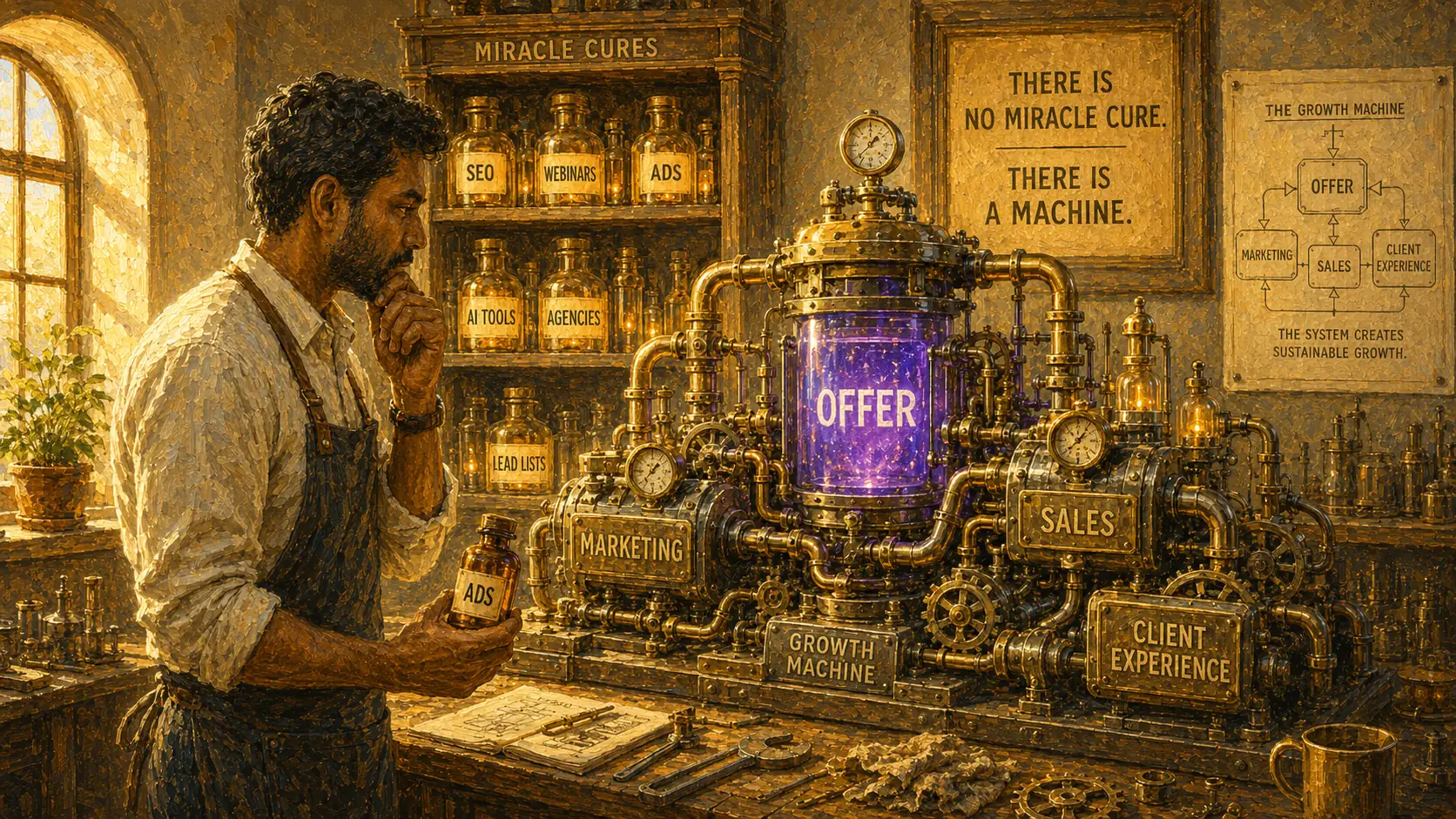
I talk to founders every week who think they're shopping for SEO. Or a webinar funnel. Or a lead list, a new agency, an AI tool, a LinkedIn ghostwriter.
They're all shopping for the same thing. The one move that finally makes growth easy.
I understand the impulse. You've been grinding for years. Referrals carried you for a while, then slowed down. You've written checks to agencies and watched the money disappear. Somewhere out there, you figure, is the tactic or the magic marketing funnel everyone else knows about. The one that will finally get it done.
Here's the slap upside the head, and I say this with love: that tactic doesn't exist. That funnel doesn't exist. They never have. And the people selling them to you know that.
Why You Keep Believing It
You believe in the miracle cure because everyone selling tactics and funnels sells them as one.
The webinar guru sells webinars as the answer. The funnel expert sells the funnel as the answer. The SEO agency sells rankings as the answer. The sales trainer sells closing skills as the answer. Every one of them holds up their piece of the puzzle and calls it the whole picture, because "this is one part of a larger system that also requires eight other things you'll have to build" is a lousy sales pitch.
So you buy the tactic. It underperforms. And instead of questioning the premise, you conclude you bought the wrong tactic and go shopping again. Google Ads didn't work, try Facebook. Facebook didn't work, try TikTok. That salesperson flamed out, hire another one.
I call this the tactic treadmill. You can run on it for a decade, spend a few hundred grand, and end up right back where you started. Plenty of founders do exactly that.
Your Business Is a Body, Not a Symptom
When you go to the doctor, you want the pill. Take this, headache gone.
But a good doctor knows your headache lives inside a system. It could be your eyes, your sleep, your blood pressure, your stress. A pill that ignores the system treats the symptom while the cause keeps doing damage.
Your business works the same way. Growth comes out of a machine with four connected parts: an irresistible offer, a marketing system, a sales system, and a client experience worth talking about. Every part has its own smaller parts inside it. And here's the brutal rule of machines: one broken piece stops the whole output.
Think about something as simple as responding to a lead. Research published in Harvard Business Review found that waiting more than 30 minutes to respond to a web lead drops your odds of ever qualifying that lead by 21 times. Twenty-one times. You can have a beautiful website, sharp ads, and a compelling service, and still lose the deal to a timestamp.
That's one bolt in one section of one machine. Now count how many bolts your growth machine has.
The Founder Who Had Everything Working (Except Two Things)
Let me make this painfully concrete.
A client of mine did a lot of things right. We built him a genuinely differentiated offer. He launched a webinar, and the webinar worked. People registered, showed up, and booked sales calls. If you'd looked at his funnel from the outside, you'd have called it a success story in progress.
But the deals were not closing.
So I listened to his call recordings, and I found two broken parts.
The first was sales. His approach, his process, his strategy, and his skill on the calls were losing deals he should have won. Twenty-five years of expertise, a great offer, real demand coming in the door, and a sales conversation that gave all of that advantage away before anyone got close to a yes.
The second one surprised me, because it hid in a part of the machine we'd already fixed. His offer came in exactly one size. A great fit if you were his ideal client today. But startups kept showing up on his calls, companies too small for the full program but a year or two away from growing into exactly the client he wanted. He had no smaller access offer to start that relationship, so those startups walked away with nothing. He was losing them twice: the small deal now and the big deal later.
His marketing was doing its job. The machine had broken parts downstream, and the whole system produced almost nothing.
"Even when a tactic works, it just moves the bottleneck."
That's the reality nobody selling you a tactic will say out loud: even when the tactic works, it just moves the bottleneck. Fix your lead problem and you'll discover your sales problem. Fix your sales problem and you'll discover your retention problem. Growing a business means finding and fixing the next broken part, over and over, until the machine runs.
Hard? Yes. Unfair? No. That's just life, and it's the same for me, for you, and for every competitor you have. Which, if you think about it, is actually good news. The founders stuck on the treadmill never get off because they're still waiting for a miracle cure that isn't coming. The founders who accept that growth takes a complete machine stop waiting and start building. Give them a year or two and they lap everybody who's still shopping for shortcuts.
The Closest Thing to a Cure
Okay, now the hopeful part.
First, try a quick exercise. Think back over everything you've changed in your business in the last five or ten years. You've probably rebuilt the website at least twice. Switched CRMs. Hired and fired a couple of agencies. Maybe refreshed the logo. Now ask yourself: when did you last redesign your offer?
For most founders, the honest answer is never. They assembled their offer on day one, usually by copying whatever everyone else in the industry was selling, and then spent a decade renovating everything around it while the thing at the center stayed exactly the same.
That's the problem, and it's also the opportunity. Because in 20+ years of this work, the closest thing to a miracle cure I've ever found is a structurally differentiated offer.
Notice the word I used. Closest. Your offer is the one part of the machine that makes every other part easier. It's the force multiplier.
When your offer is genuinely different, built around a real Market Crux™ and a Differentiation Device™ your competitors can't copy, marketing gets easier because you finally have something worth amplifying. Sales gets easier because prospects can see the difference without a 45-minute pitch explaining it. Retention gets easier because you attracted the right clients with the right expectations from the start. Price pressure drops because comparison shopping stops making sense when nobody else offers what you offer.
That's one improvement felt everywhere in the system at once. No tactic can make that claim.
And here's the part that should give you real hope. You can't control your market, your competitors, or the next algorithm change. Your offer sits entirely inside your control. Redesigning it takes real work, but the decision to finally do it takes about a minute.
Even the Cure Needs the Machine
Now the second slap, because I promised you honesty over hype.
A structurally differentiated offer, by itself, sitting in a drawer, earns you nothing. My client had one. He still needed the webinar built, the sales process fixed, and the follow-up dialed in. And remember, even the offer itself needed a revision once real sales calls exposed a buyer it didn't fit. Your offer is a part of the machine too. You'll design it, run it, and improve it just like everything else. The offer made all the other work dramatically better. It replaced none of it.
Unless you invent an actual miracle cure for an incurable disease, your differentiated offer still needs a marketing system to carry it to the market, a sales system to convert the demand it creates, and a client experience that turns buyers into evangelists. It needs time. It needs tweaking. You'll launch, measure, find the broken part, fix it, and go again. That cycle never fully ends, and the founders who win are the ones who make peace with that.
The offer is the engine. The engine is the most important part of the car. You still need the wheels.
Stop Shopping. Start Diagnosing.
So here's what to do with all this.
Retire the question you've been asking, which is some version of "what tactic or funnel haven't I tried yet?" Replace it with the question a doctor would ask: "which part of my machine is broken, and why?"
Maybe it's your offer, and if you're honest with yourself, it usually is. Maybe your offer is solid and your sales process is leaking deals. Maybe everything upstream works and your delivery is quietly killing your referrals. You can't know until you diagnose, and you can't diagnose while you're sprinting after the next shiny tactic.
Growth is hard. It takes all the parts and pieces, connected and working together. Anyone who tells you otherwise is selling you one of the pieces.
But hard and hopeless are very different things. The machine can be built. The parts can be fixed, one at a time, in the right order. And the founders who start with the offer build machines that run faster, cost less to feed, and demand far less of their own sweat to keep turning.
Start with the part that makes every other part easier.
Not sure which part of your machine is broken?
The Offer Design Assessment is a five-minute self-scoring tool that shows you where your offer is strong, where it's soft, and what to fix first.
Take the Assessment →