Give me six minutes and I'll show you the first key element of designing an offer that makes marketing and sales finally work. Hit play, and if you came here from the Profitable by Design newsletter, welcome to the first issue.
Read the transcript
Hello, my name's Forrest Dombrow. I'm the founder of Profitable by Design. We've got a quick training for you today on the first key element of designing a structurally differentiated offer.
So first of all, why is creating a structurally differentiated offer important in the first place? Well, every industry these days is very competitive. Here, I did a search for custom software development, and pretty much every title says exactly the same thing. And when you click through to a few of these websites, they also say the same thing. They all look and sound like everybody else. That's what I call the sameness trap.
That's what makes it hard to get picked off Google, to get booked for a call, to close a deal, even if you have a great service and lots of happy clients. On the surface, a lot of times if I went to your website or you gave me your elevator pitch, it would probably sound and look just like everybody else in your industry, or pretty similar anyway.
So let's revisit our key statement here. What do I mean by structurally differentiated? When I tell people I do offer design, they often say things like, "Do you mean like branding or messaging?" And I don't mean that.
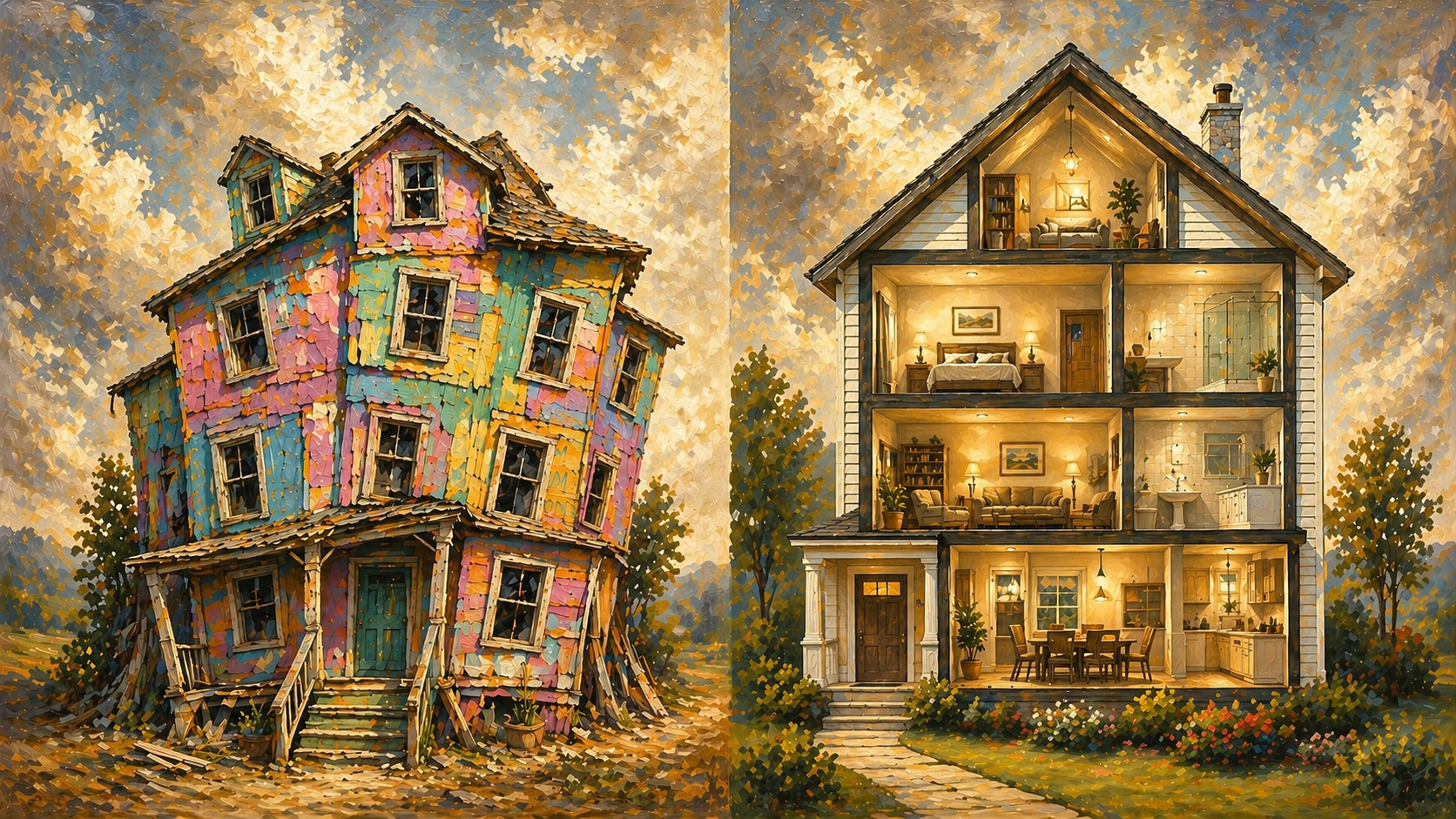
Let me illustrate with an example. Imagine you have a two-bedroom house. You want it to be four bedrooms because your family's growing. So what do you do? You go outside and you paint it. You still only have two bedrooms, right?
Structural differentiation is actually about changing the structure of what you offer, building the other two bedrooms, so it's actually different. It doesn't just sound different. Because what we say here is a better description of an average offer is still an average offer. It's still a two-bedroom house.
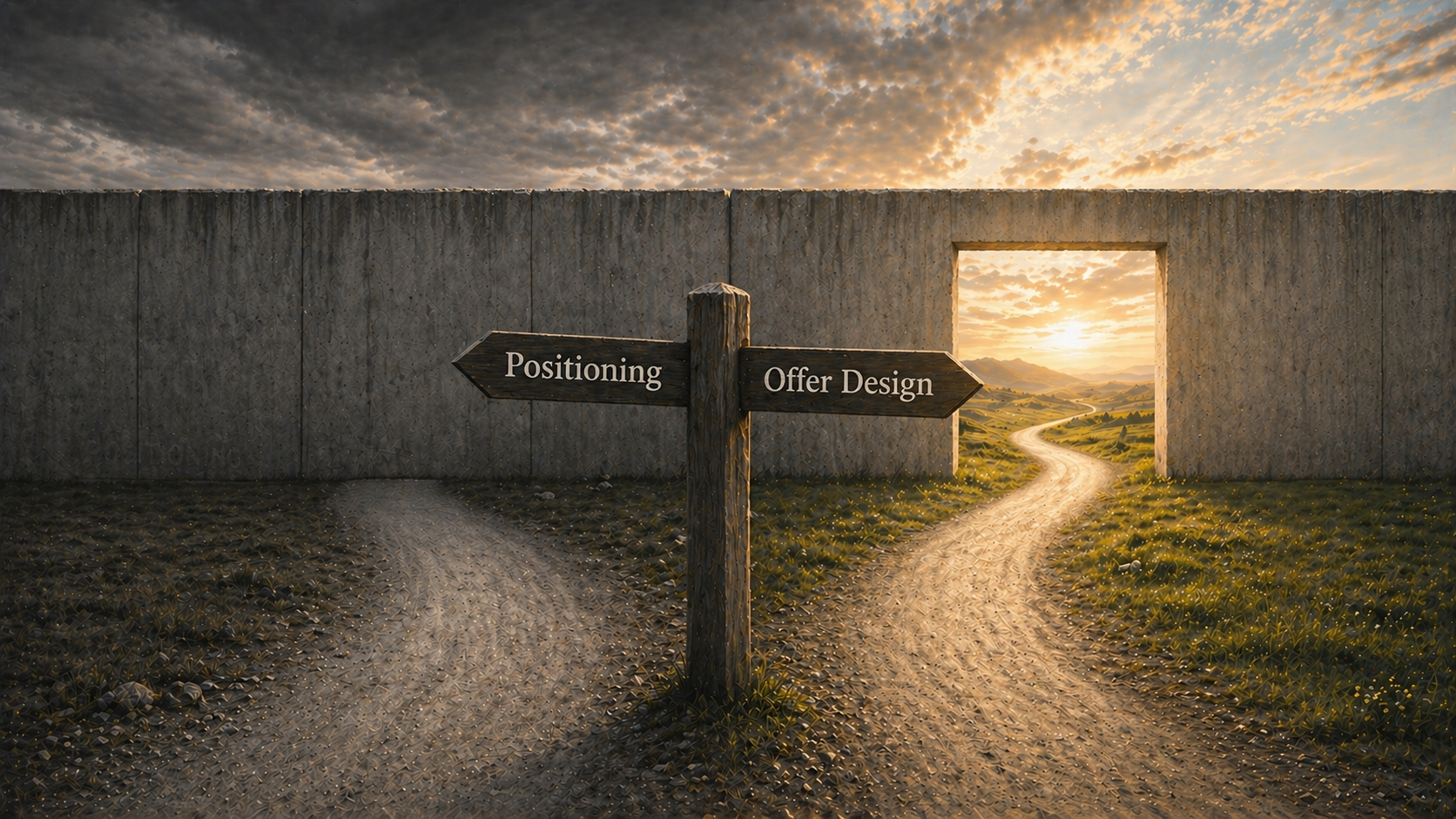
Now, don't get me wrong, I love branding, positioning, and messaging, and they certainly can be helpful. However, they should come after you structurally differentiate your offer, which is why our offer design programs include both. First, we create the structural differentiation, then we create the messaging and positioning.
So let's get into the actual training. How do you get started? What's the first key step? Imagine you're at the convenience store, you see this rack, and you're like, "You know what? I feel like a pack of gum." So you scan the shelf and you narrow it down to a few options. Now, in your head, I want you to pick your favorite one out of these five here. It's not a trick question. Just pick one.
All right, if you've got it, if I went and asked you, "Why did you pick the pack of gum that you picked?" I guarantee you will have at least one reason why, for you, that pack of gum was different and better in some way. Maybe you love cinnamon, so you pick Big Red. Maybe you hate cinnamon, so you pick something else.
And that's how buyers buy just about everything, from a pack of gum, to a house, to custom software. They decide they need something. They have a problem they want to solve, or they just want something, and then they go find some options: Google searches, AI searches, asking friends and family. Then they compare and contrast. What does this one offer that this one doesn't? What's the price on this one? They compare all the different things, and then ultimately, everybody does this. They pick the one that is different in at least one way that makes it better, and that's where offer design lives.
How do we, on purpose, design and engineer an offer that stands out as not just looking different, but actually is different, and it sounds different in a way that makes it better?
But here's a problem with the word better. What's better to you might be the worst thing for somebody else. If you love cinnamon, you pick Big Red gum. Maybe the next person hates cinnamon, and they pick Juicy Fruit. So it's not that cinnamon's better or Big Red's better. It's better for you. So that's the point. Better is subjective.
So how are we supposed to create an offer when we're not sure what's going on in somebody's head and what they think is the best? Well, that's what today's lesson is about.
So imagine I said to you, "Hey, do me a favor. I need you to write a letter," and that's all I said. You couldn't write it. You need more information. Who am I writing a letter to? What is it about? What's the topic? What do I want someone to do after they're done reading it? Call me? Buy something? Laugh? Cry? You need to have a focus, and the same is true for offer design.
Now, you may serve a bunch of different industries. You can solve a lot of different problems for people. But the problem with that is if your offer's for everyone, it's for no one. So when we do offer design, we're creating it for a specific audience, so that we know who we're writing a letter to, who we're creating the offer for.
All right, so there are four steps of offer design. We're just going to go over the first one today, and that is picking a Population in Pain. That's like figuring out who we're writing a letter to.
So a Population in Pain, what is that? It's simply a specific group of people with the same or similar problem. Because now we can create an offer for that group with that problem. And by design, it will exclude everybody that's not in the group.
So it could be as simple as men over 40 with lower back pain. Or healthcare companies whose software is broken, if you do custom software. The point is they're all the same or similar, and they all have the same or a similar problem. So now I can create an offer. Do you have lower back pain? Yeah. And everybody that doesn't have lower back pain is going to say, "That offer's not for me." And you can have as many offers as you want, but we do one at a time for a specific Population in Pain.
Now, there are six factors we use, or filters, to figure out if a Population in Pain is going to be viable, if it's going to be worth your time to create an offer and go market it. If you would like to see what these six factors are, simply reply to the email that led you to this video. If you didn't come through the email and you found this video some other way, go to offerdesign.com, fill out the form, and we'd be happy to share this slide with you with all the filters.
Hope you found this training useful.
Notes From the Training
The Sameness Trap
Search for almost any B2B service, custom software development for example, and most of the results say nearly the same thing. Click through to a few of the websites and they say the same thing too. I call that the sameness trap.
The sameness trap makes it hard to get picked off Google, hard to get booked for a call, and hard to close the deal, even when you have a great service and a long list of happy clients. If I visited your website or heard your elevator pitch, there's a good chance it would sound a lot like everybody else in your industry.
Structural Differentiation Means Building the Bedrooms
When I tell people I do offer design, they often ask whether I mean branding or messaging. Here's the example I use to explain what I actually mean.
Say you have a two-bedroom house. Your family is growing, so you want four bedrooms. You grab your overalls, a can of paint, and a brush, and you paint the outside of the house. After you're done painting, how many bedrooms do you have?
Still two.
Structural differentiation means changing the structure of what you offer. You build the other two bedrooms, so the offer is actually different and sounds different as a result. A better description of an average offer is still an average offer. It's still a two-bedroom house.
I love branding, positioning, and messaging, and they help a lot. They work best when they come after the structural work. That's why our offer design programs build the structural differentiation first and then create the messaging and positioning on top of it.
Every Buyer Picks the One That's Better for Them
Picture yourself at a convenience store, looking at a rack of gum. You narrow it down to five packs and pick one. If I asked you why you picked that pack, you'd have at least one reason it was different and better for you. Maybe you love cinnamon, so you grab Big Red. The next person in line hates cinnamon, so they grab Juicy Fruit.
That's how buyers buy just about everything, from a pack of gum to a house to custom software. They decide they need something. They find a few options through Google, AI search, or friends and family. They compare what each one offers and what each one costs. Then they pick the one that is different in at least one way that makes it better for them. I wrote more about that moment in Your Offer Needs One Great Reason.
That moment of choice is where offer design lives. The work is to design your offer on purpose so it is different in a way that makes it better, and so it looks and sounds that way to the buyer.
The catch is that "better" is subjective. Cinnamon is the best thing in the world to one buyer and the worst thing in the world to the next. So how are you supposed to design an offer when you can't see what's going on inside a buyer's head?
Start With Who You're Writing To
Imagine I asked you to write a letter, and that's all I said. You couldn't write it. You'd need to know who the letter is for, what it's about, and what I want the reader to do once they finish it. Call me? Buy something? Laugh? Cry?
Offer design works the same way. Many service businesses serve a bunch of different industries and can solve a lot of different problems. When an offer is built for everyone, it's built for no one, because no buyer reads it and recognizes their own problem.
So the first of the four steps of offer design is picking a Population in Pain. That's how you figure out who you're writing the letter to. You'll find this term and the rest of the Offer Design vocabulary on The Language page.
Population in Pain
A specific group of people who share the same problem, or a very similar one. Men over 40 with lower back pain is a Population in Pain. So are healthcare companies whose custom software is broken.
Once you pick the group, you can build an offer for that group and that problem. Ask "Do you have lower back pain?" and the people who have it lean in. Most people without back pain decide the offer is meant for someone else, and that's exactly what you want. By design, a good offer excludes everybody outside the group.
You can have as many offers as you like. We build them one at a time, for one specific Population in Pain at a time.
"A better description of an average offer is still an average offer."
How to Tell If a Population in Pain Is Worth It
We run every Population in Pain through six filters. They tell you whether that group is worth your time, worth building an offer for, and worth taking to market.
Get the six filters
If you came here from our email, simply reply to it and ask for the six filters. If you found this page some other way, fill out the short form and we'll send you the slide with all six.
Request the Six Filters →Frequently Asked Questions
What is a structurally differentiated offer?
A structurally differentiated offer is one where the structure of what you deliver, meaning what the buyer gets and how it works, is different from competing offers in a way that makes it better for a specific buyer. It changes the offer itself, the way adding two bedrooms changes a two-bedroom house. Branding and messaging then describe that difference to buyers.
What is a Population in Pain?
A Population in Pain is a specific group of people who share the same problem, or a very similar one. Men over 40 with lower back pain is a Population in Pain. So are healthcare companies whose custom software is broken. Picking one lets you design an offer for that group and that problem.
What is the first step in offer design?
The first of the four steps of offer design is picking a Population in Pain. It works like knowing who you're writing a letter to before you start writing. Once you know the group and their problem, you can design an offer that is better for them.
Should branding and messaging come before offer design?
Offer design comes first. Branding, positioning, and messaging are valuable, and they work best once the offer underneath them is structurally different. Our offer design programs build the structural differentiation first and then create the messaging and positioning on top of it.
Why does my service business sound like every competitor?
Most B2B service businesses describe similar offers in similar language, so their websites and pitches blend together. I call this the sameness trap. It makes it harder to get found, booked, and chosen, even with a great service and happy clients. Designing a structurally differentiated offer for a specific Population in Pain is how you get out of it.
One more thing for newsletter readers. Reply to the email with the word "book" and I'll send you a free digital copy of Clone the Ace, my bestselling book on building a sales process that's repeatable, scalable, and highly effective.
We'll be back next week with more.