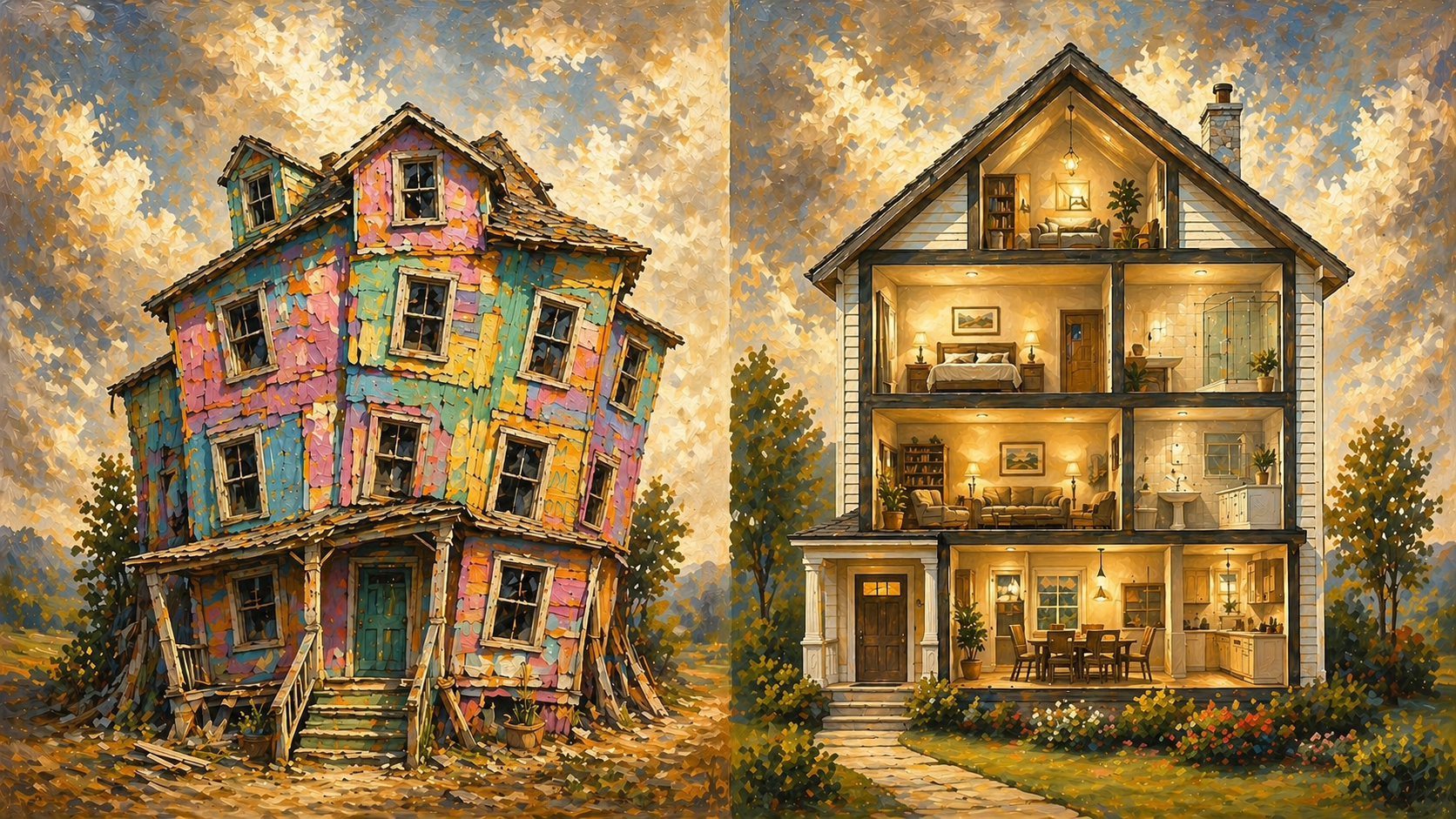
Picture this. You need a four-bedroom house. You've got a growing family, and four bedrooms is the whole point. But the four-bedroom listings are out of budget, so you buy a two-bedroom instead. Then you tell yourself the gap doesn't matter, because you'll fix it with paint. Fresh color on the walls. A bold front door. New trim. From the curb, it'll look like exactly the home you wanted.
It won't. No amount of paint adds a bedroom. The family moves in, and the house is still too small for what they actually needed. That's the trap most service businesses fall into when they try to differentiate. They want a genuinely different offer, they can't easily build one, so they reach for the paint.
There are two ways to differentiate a service business offer. One actually works. The other creates the appearance of differentiation long enough for you to spend a significant amount of money discovering it doesn't.
Understanding the difference between the two isn't just conceptually useful. It changes the entire sequence of decisions you make when building or repositioning an offer.
Language-Based Differentiation: The One That Doesn't Work
Language-based differentiation is the paint. You take what you already do, and you find better words for it. You work with a copywriter or a brand strategist. You build a positioning statement. You rewrite the website. You sharpen the elevator pitch. The underlying offer stays the same. Only the description changes.
This isn't without value. Good language matters. Clarity matters. A sharp description of a genuinely different offer is a real asset. But here's the problem. Language-based differentiation applied to an undifferentiated offer is cosmetic. You're painting the two-bedroom house and hoping the market doesn't notice there are still only two bedrooms.
Buyers see past it. Not always immediately, but eventually. They hear the language, it sounds compelling enough to get a meeting, and then in the room they realize the offer sounds like every other offer they've heard. The paint promised a four-bedroom house. The structure delivered two. That gap erodes trust faster than almost anything else in a sales process.
"You can't describe your way into meaningful differentiation. A better description of an average offer is still an average offer."
Structural Differentiation: The One That Does
Structural differentiation is different in kind, not just degree. It's the renovation, not the paint. It lives inside the offer itself. It includes who the offer is for, what problem it actually solves, how it solves it, and what makes the approach genuinely different in a way that delivers superior value and competitors can't easily copy.
When structural differentiation is present, the language almost writes itself. You're not searching for better ways to describe the same thing. You're describing something that is genuinely different. That's a much easier problem to solve, and the result is much more durable.
Structural differentiation is grounded in two concepts. The Market Crux is the false assumption the market holds about what's preventing the outcome buyers want. Everyone in the market shares this assumption, buyers and competitors alike. When you find it, you find the leverage point around which a truly differentiated offer is built. The Differentiation Device is the mechanism your offer uses to solve the real problem differently. Not a tagline. Not a claim. How the offer actually works in practice, in a way competitors aren't working and can't easily replicate.
Why "Built In" Beats "Bolted On"
The phrase captures the key distinction. Language-based differentiation is bolted on after the offer is built. It's an add-on, a layer placed over something that already exists. It's the coat of paint over the wrong house. Structural differentiation is built in from the start. It's the floor plan. It's woven into the offer's core design.
The practical consequence of this difference is significant. Language-based differentiation can be copied overnight. A competitor can read your website, see the positioning language you're using, and adopt similar language by the end of the week. There's nothing proprietary about words.
Structural differentiation is much harder to copy. If your offer is built around a genuine insight about what the market has been getting wrong, and your mechanism solves that problem in a way competitors haven't figured out, replicating your approach requires understanding the Crux, rebuilding the offering from scratch, and training a team to deliver it. That takes time. Often years. That time gap is a real competitive moat. You can repaint a house in a weekend. You can't add two bedrooms in one.
Wondering which type of differentiation your offer has? The Offer Design Assessment reveals where your differentiation lives and whether it's structural or cosmetic.
Take the Assessment →The Sequence That Changes Everything
Once you understand this distinction, the right sequence becomes obvious. You do Offer Design first. You get the structural differentiation right, the Crux and the Device working together. You build the four-bedroom house. Then you do positioning and messaging. Then you do marketing. In that order, the language reflects something real, and the marketing amplifies something worth amplifying.
Get the sequence wrong, jump to messaging and marketing before the offer has structural differentiation baked in, and you spend money discovering that the market isn't responding. Which leads to more messaging experiments, more marketing spend, and the same slow results. That's the loop most service businesses are stuck in. Buying more paint for a house that needed another floor.
Built in beats bolted on. Not as a slogan. As the organizing principle for every offer design decision that follows.